.png)
.png)
.png)

What is vanadium?
Vanadium is the 23rd element in the periodic table and is primarily used as an alloying material in the tool manufacturing industry.
In addition, it is a metal with a high electrical density that is used in electrolyte solutions, for example in a redox flow battery.
Vanadium is used because of its unique ability to access four different oxidation states: V2, V3, V4 and V5 (VO2 to VO5).
Most organic materials contain very small amounts of vanadium, but for industrial use it is extracted either from slag generated during iron and steel production or through chemical processes.
What is a Vanadium Redox Flow Battery (VRFB)?
A VRFB is based on a technology whose principles were originally developed in the 1940s. The technology was not previously a commercially viable solution for energy storage, but with the support of new technologies and developments, VisBlue has been able to develop a commercial VRFB for storing energy produced by solar power systems.
During the day, when solar panels generate electricity, it is not necessarily at a time when that electricity is needed. This leaves us with two options.
We can sell the surplus electricity back to the grid, often at a financial disadvantage, or we can store the surplus energy.
In the evening, when solar panels are no longer generating electricity, energy must be sourced from elsewhere. A VRFB makes it possible to store energy during the day and use that same energy in the evening.
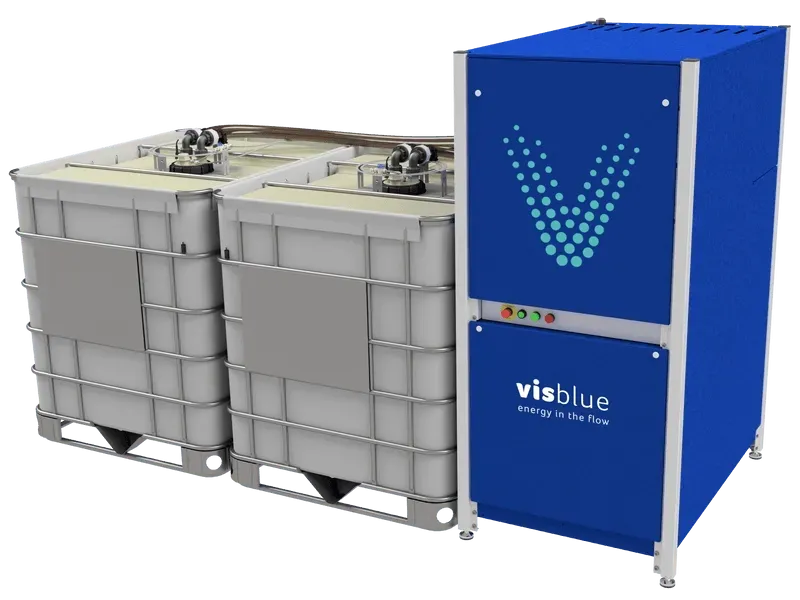
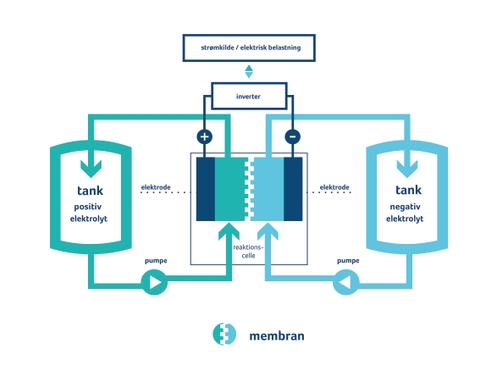
A VRFB consists of two tanks filled with a vanadium based electrolyte solution and a stack.
The stack contains several stack cells made up of a plastic frame, a graphite polymer composite bipolar plate and a polymer membrane. The number and size of the stacks depend on the required power output.
The size of the tanks determines the battery's energy capacity. The liquid in the two tanks functions as the cathode (positive electrolyte) and anode (negative electrolyte), just as in a conventional battery.
The unique ability of vanadium to achieve four oxidation states is crucial, as it allows VisBlue to use the same electrolyte solution in both tanks.
What are the advantages of VisBlue's Vanadium Redox Flow technology compared with other redox flow technologies?
What distinguishes VisBlue's VRFB from other redox flow batteries is the properties of the electrolytes. The use of vanadium rather than other electrolyte solutions makes it possible to use the same liquid in both battery tanks. This is a significant advantage because it reduces the risk of cross contamination between the electrolyte solutions and therefore eliminates problems associated with electrolyte degradation.
Another advantage is the independence of energy capacity, determined by the volume of electrolyte, and power output, determined by the size and number of stacks. As these two components are separate, it is possible to tailor a battery to specific needs and requirements.
Is a Vanadium Redox Flow Battery safe?
VisBlue's battery solution contains a vanadium based solution consisting of water and sulphuric acid.
The majority of the solution is water, which means that even in the event of a short circuit, intense heat or high pressure, the battery will not catch fire. The battery may release heat, but not at a level that would make it unsafe to touch.
Vanadium redox flow batteries do not contain unstable combinations of lithium, cobalt or nickel, unlike some other battery technologies.
In addition, VisBlue's battery does not emit gas. In the event of a leak, there is no risk of releasing toxic substances into the surrounding air. However, the tanks contain a corrosive solution consisting of sulphuric acid and vanadium, and we therefore advise against any direct contact with the liquid.